AWPA Navigation Trial
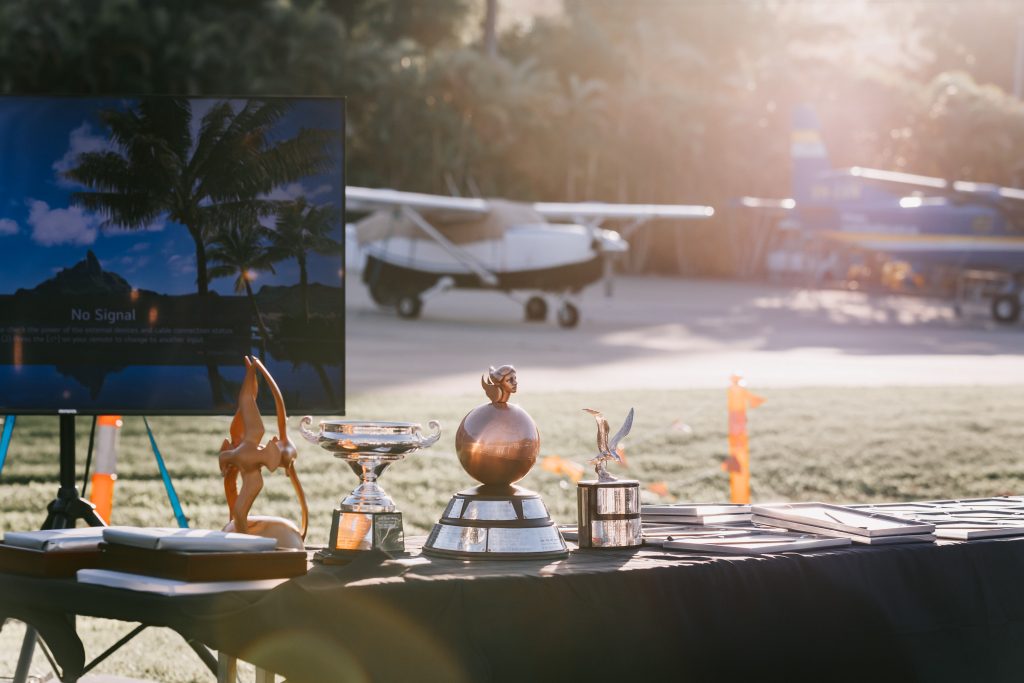
Navigation Trial Trophies
There are multiple Navigation Trial Trophies and Prizes that are awarded to crews who achieve the highest results in certain Categories.
There are two sections to the trial with section A open to members only and section B open to members and non-members.
Prizes are presented to the winning crews of both sections with Perpetual Trophies also awarded in Section A. You may be eligible to enter more than one category in Section A which is divided into the following:
Section A – Members Only
Category 1 criteria:
The overall winners of the Navigation Trial in a single engine aircraft.
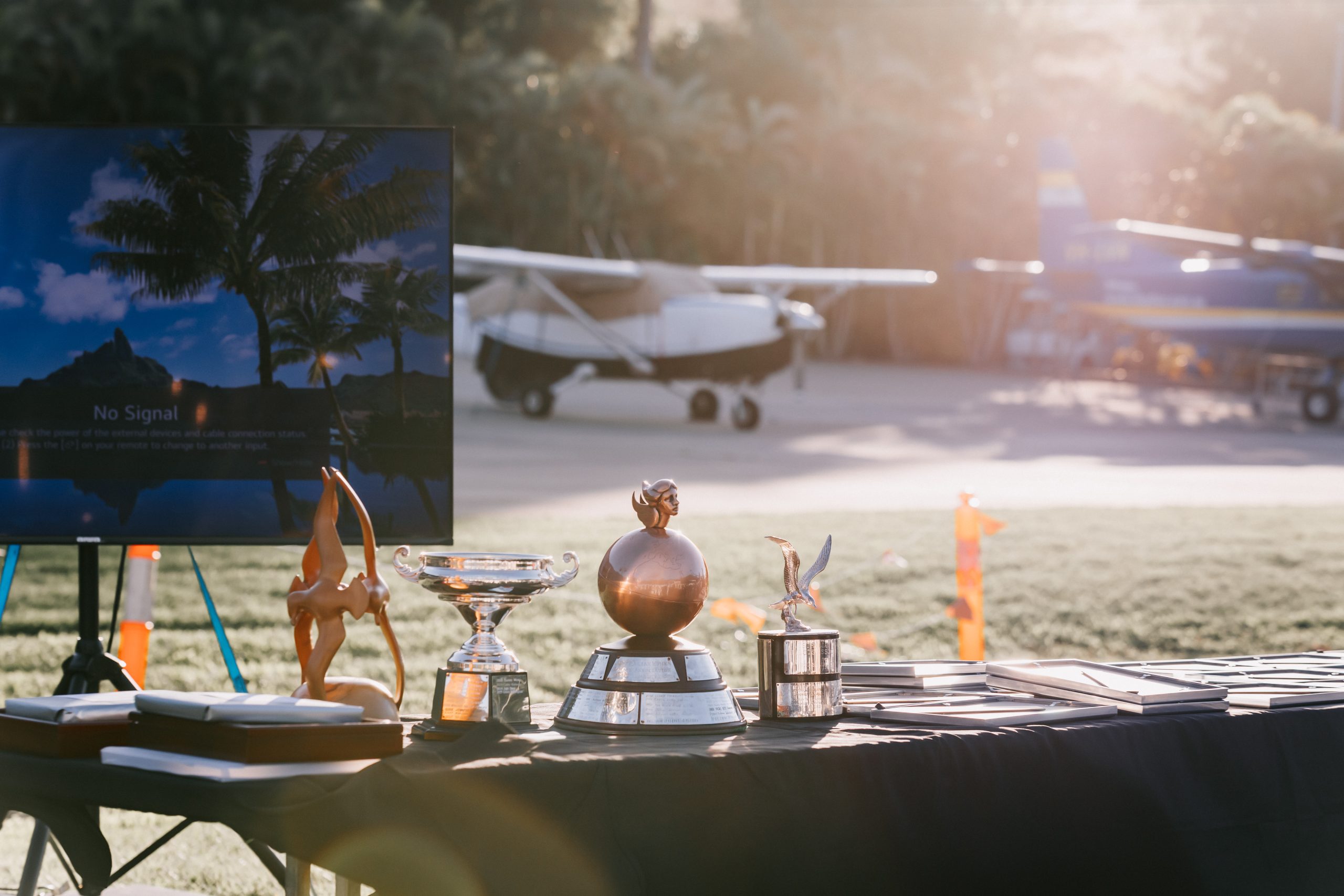
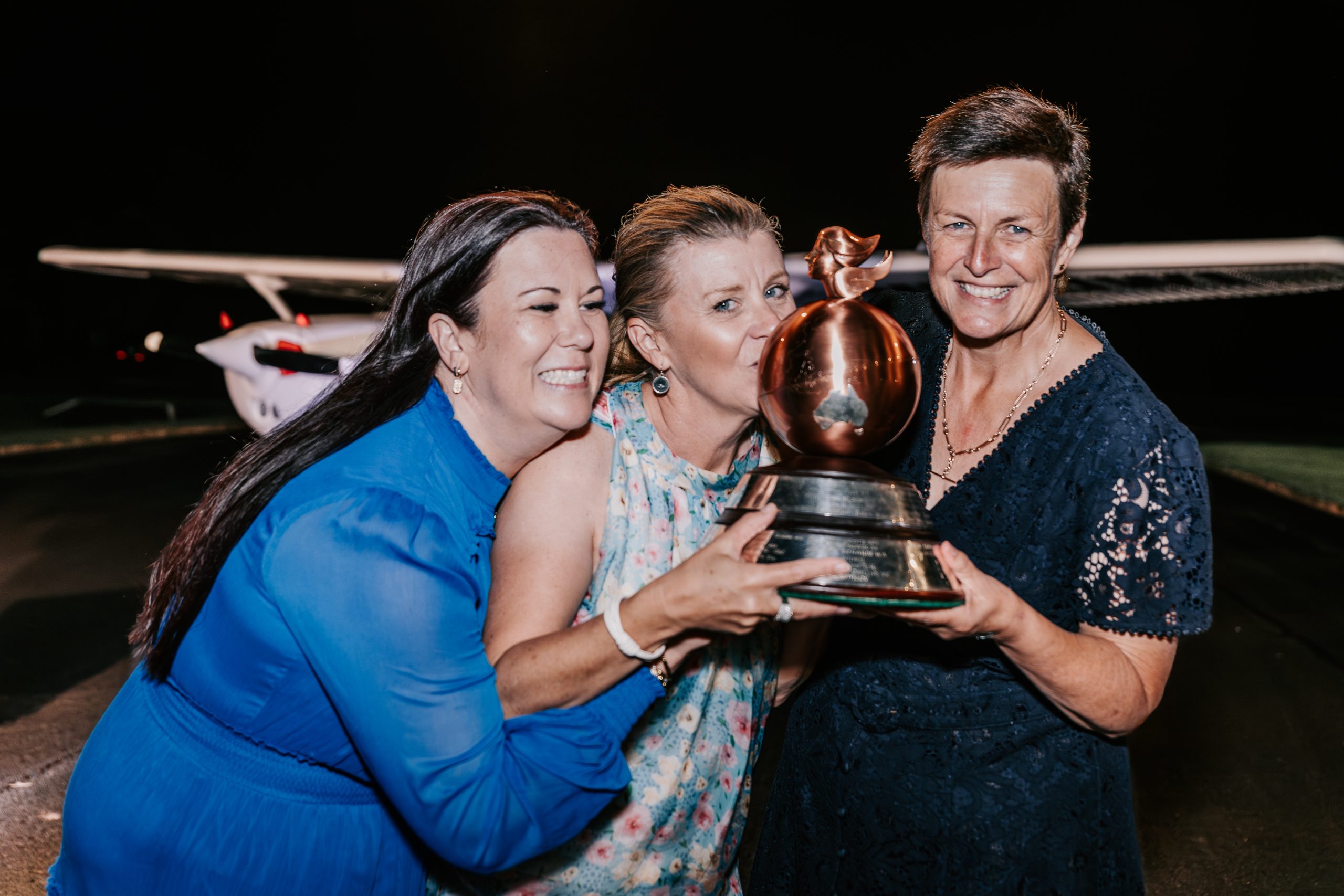
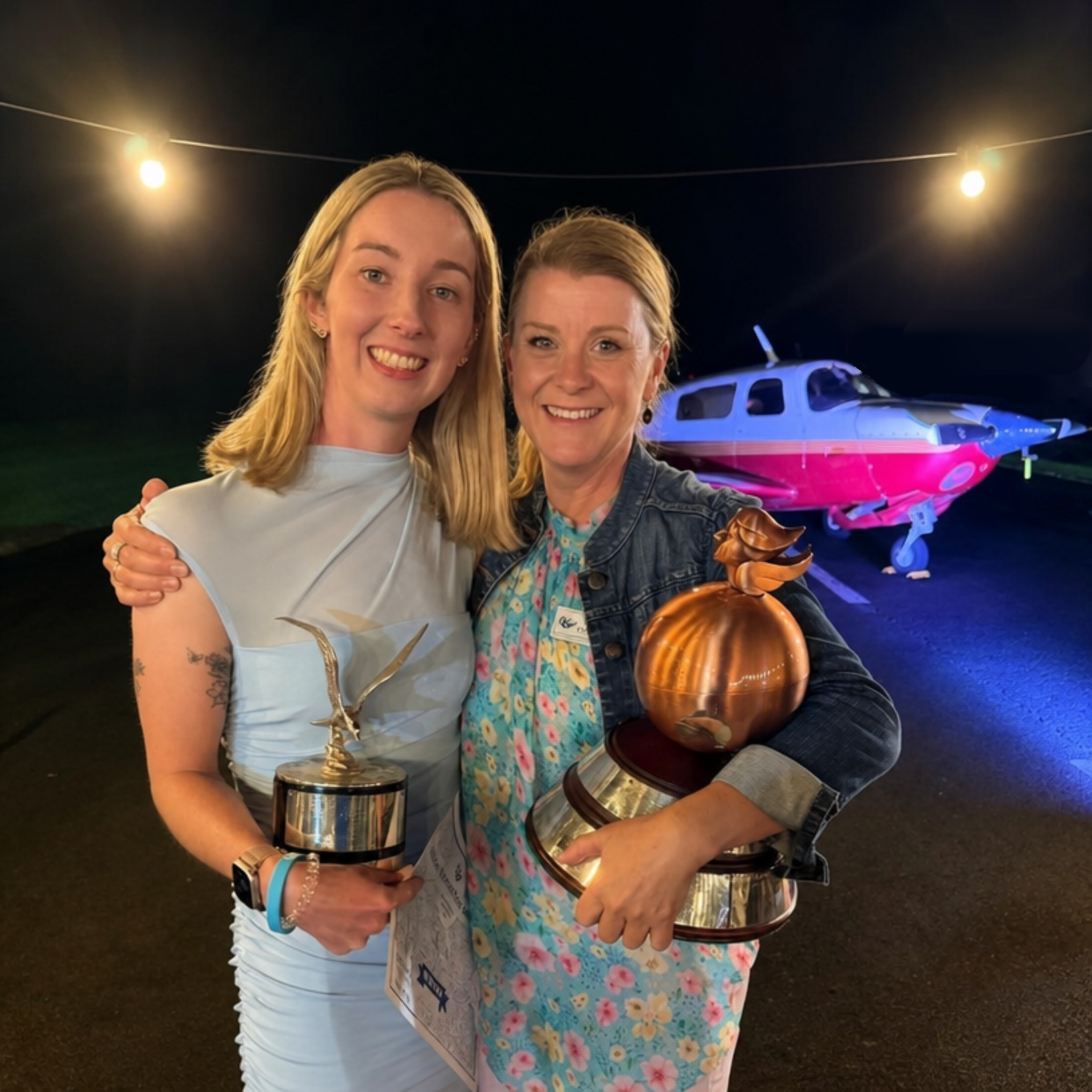
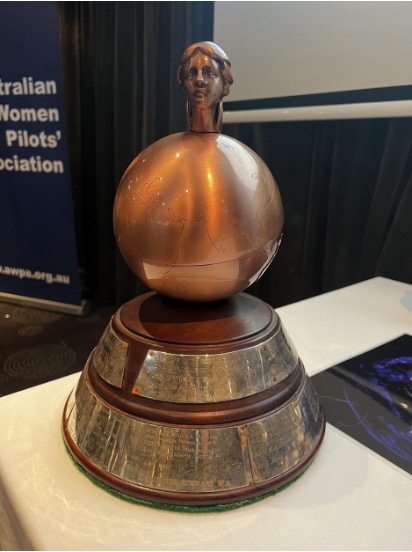
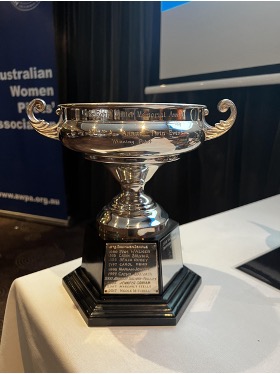
AWPA Trophy (Gertie) – Awarded to the winning pilot
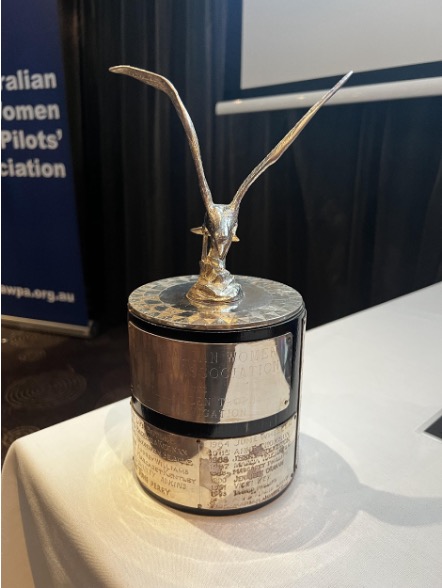
Willsallen Trophy – Awarded to the winning navigator.
Background:
AWPA Trophy (Gertie)
The AWPA Navigation Trials started in 1953 and were known as the Air Reliability Trial. The first AWPA Air Reliability Trial was won by Hazel Roberts of Richmond, NW Queensland in 1953.
Victorian member, Stephanie Day’s art design for a perpetual trophy for the Air Reliability Trial was accepted and cast in bronze on a blackwood base. The ‘ladyhead’ was designed for the AWPA badge and included on the trophy – that artwork was by Alix Newbigin, NSW.
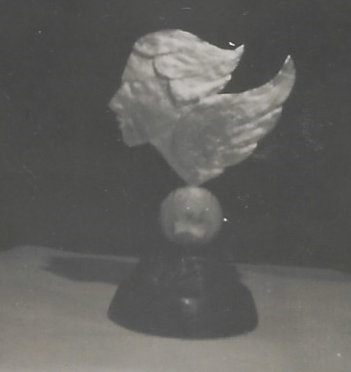
The trophy is now known as the AWPA Trophy aka ‘Gertie’ for the winning pilot of the Air Navigation Trial. The first winner to receive the Gertie trophy was Grace Cavanagh in 1955 and it was presented in Melbourne.
The trophy was altered to what it is today due to it being too big and heavy for transport in the light aircraft of the day. The original trophy was altered not once but twice however we cannot ascertain when these changes were made. The original version had a large ladyhead on the top with a smaller orb and base. The second variation is similar to what Gertie is today but only had one layer of blackwood as a base. At some stage, another layer of blackwood was added to the base, to allow for more winning pilot names to appear on the trophy and this is the trophy we have today.
Willsallen Trophy
Tika Willsallen (1921 – 2011) was a volunteer army truck driver when, during the Second World War at a staff dance at Duntroon, Canberra, she met Peter Willsallen, a major in the army. After marrying, Tika and Peter settled at ‘Widgeongully’, Jugiong, NSW where they lived until 1982. They then moved to Cootamundra and finally to Woollahra, Sydney.
Tika had always had a yearning to fly – it was in the blood. Her brother Bob McMaster became Chief Pilot of Qantas, his son John became a Qantas check captain and a grand nephew, a Qantas captain.
In 1963, Tika learnt to fly at Cootamundra in a C172, gaining her PPL in 1964 at the age of 43, which was quite rare for a woman in those times. Tika joined AWPA in 1964 and remained a dedicated member for 47 years. She had a strong interest in AWPA AGMs and nav trials, competing in many events over the years. In 1976 and 1977 with Lyn Butler as navigator, Tika won the AGM nav trial in her C182, VH-DKO.
Tika and Peter hosted several AWPA fly-ins at their beautiful Jugiong property, two of which followed AWPA receptions at Yarralumla hosted by the then patron, Lady Maie Casey. Tika was an exceptional host and her generosity towards AWPA was outstanding
Some interesting aspects of her flying life included a trip from Australia to England in their C310 in 1970. Tika and Peter, along with cousin Michael Willsallen (also a private pilot) shared the flying. This was a remarkable feat for VFR private pilots in those days. Seventy-three hours in 15 days from Cootamundra to England and sixty – nine hours 13 days return to Cootamundra.
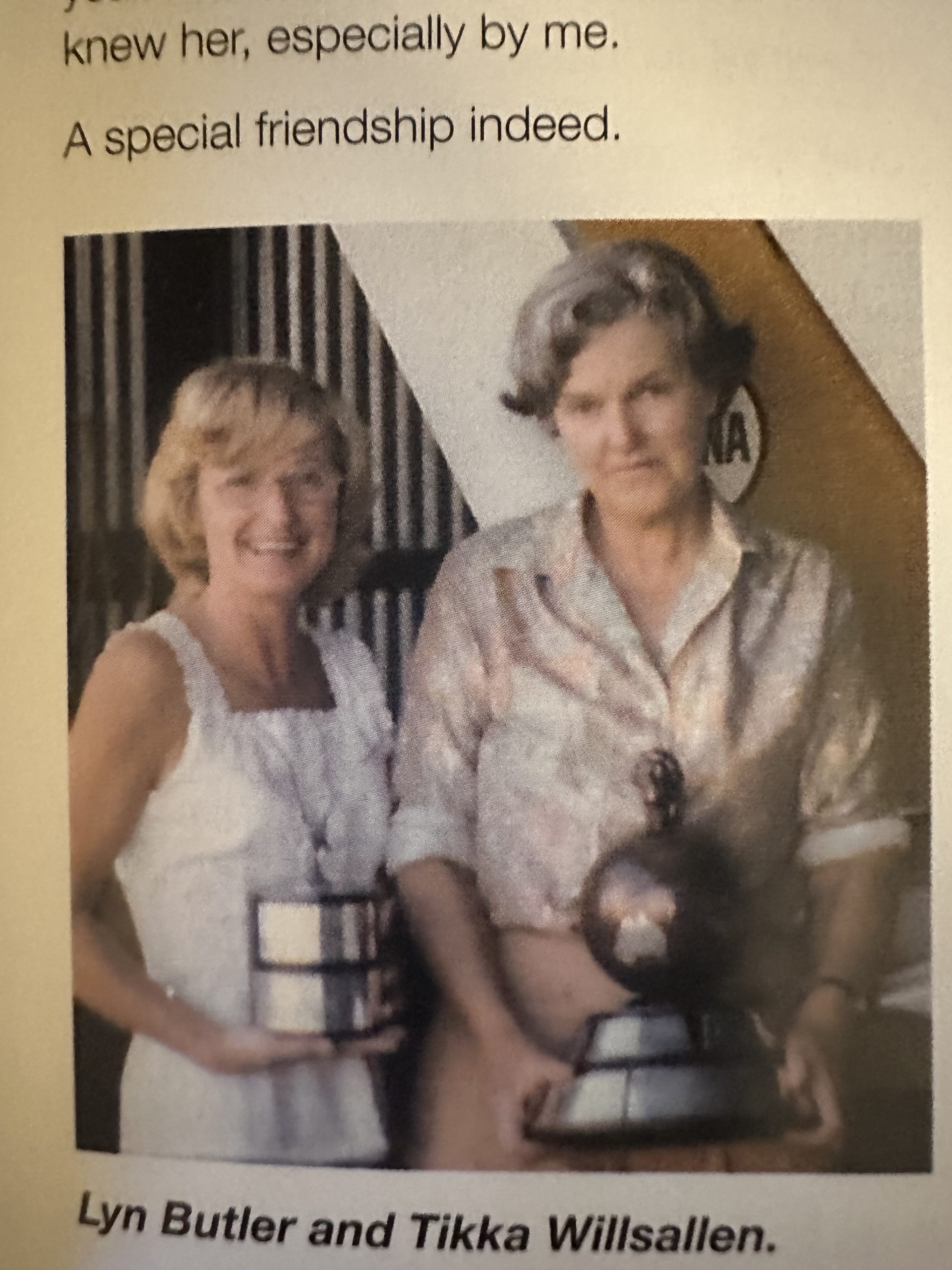
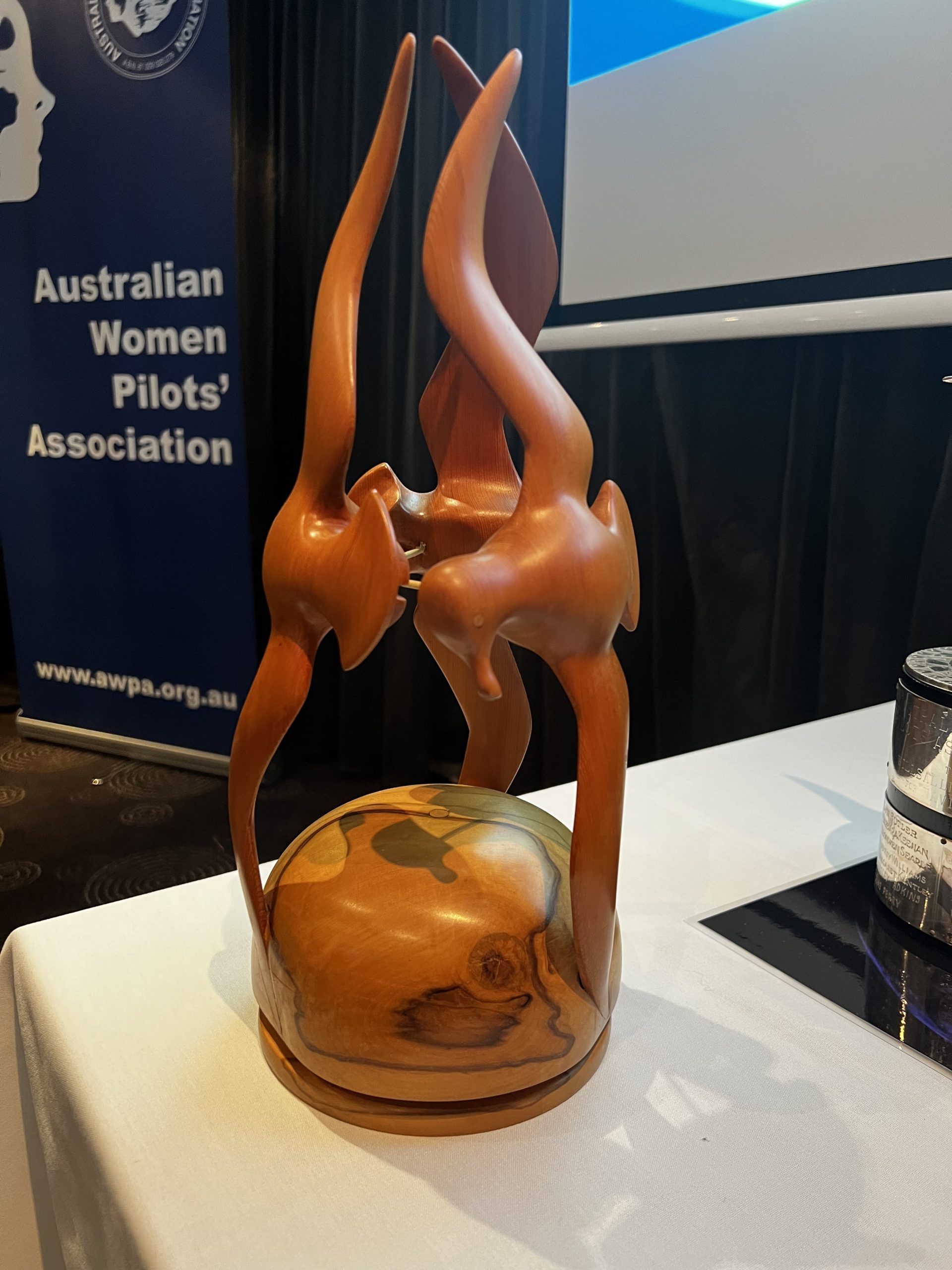
Tika decided that a trophy should be awarded to the navigator of the winning team in the Navigation Trial. In 1976, on another trip overseas to London, she had a trophy made that she designed herself featuring a frigate bird in antique silver and it has become the famous Willsallen Trophy (see the photo).
Tika was a capable lady in many fields. She was a meticulous pilot and flew always with competence and excellence. She continued to fly regularly and the final entry in her logbook was April 1992, a total of 1,215 hours. She was a highly respected member of AWPA and always maintained great interest in their activities even after giving up her flying. Tika’s contributions to AWPA are admirable. Though she was not able to attend AGM’s in her later years she always sent an apology and enjoyed hearing reports regarding the activities and people involved.
Tika’s memory lives on through the Willsallen Trophy.
Category 2 criteria:
The crew can fly a twin-engine aircraft or a single- engine aircraft with a CSU and a TAS of 125kts or higher. The category requires a minimum of 3 aircraft entered for this category to be awarded. Crews taking part in category 2 cannot be eligible for category 1.
Robin Miller Trophy – Awarded to the Winning Pilot
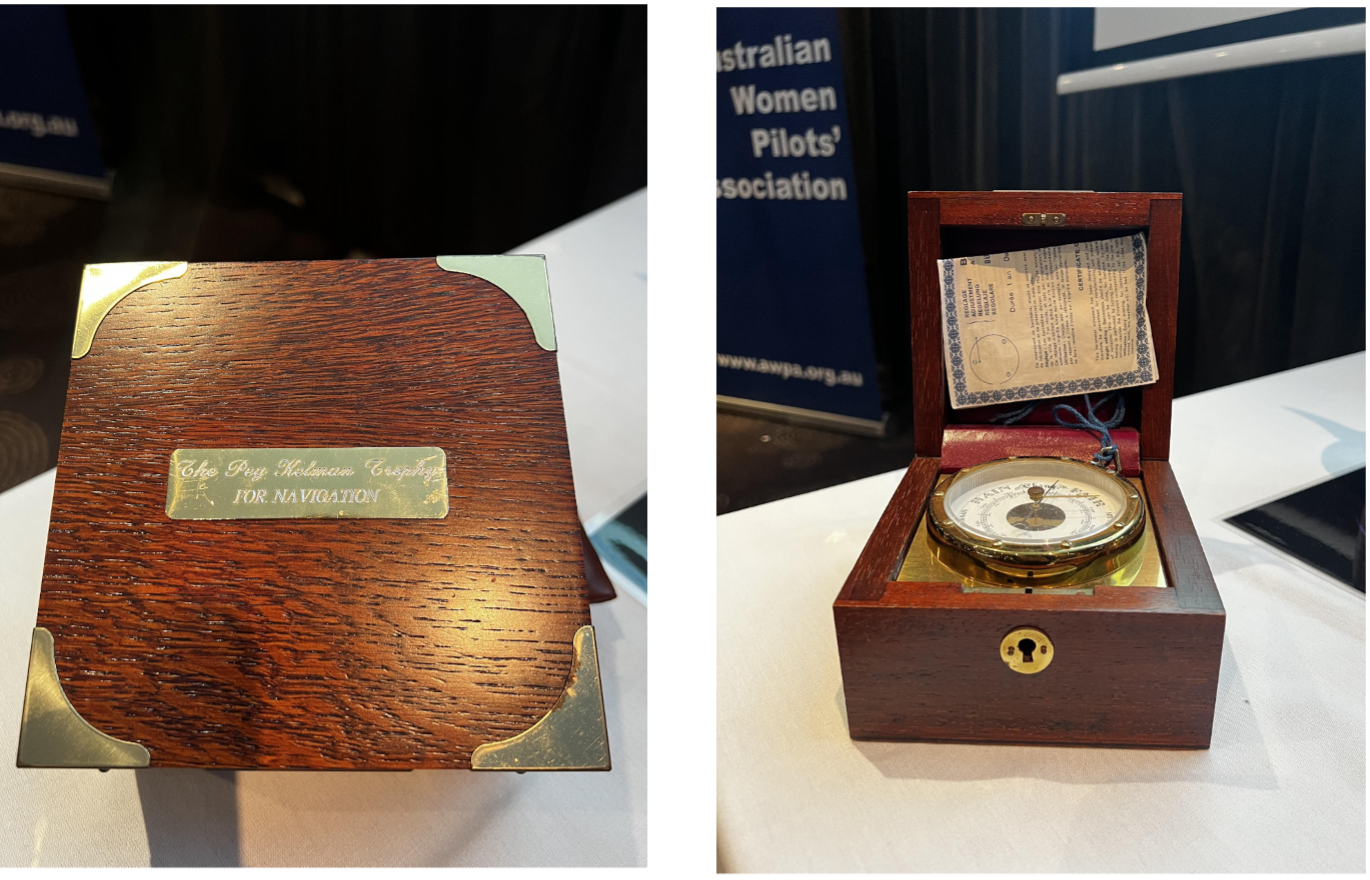
Peg Kellman Trophy – Awarded to the Winning Navigator
Background:
Robin Miller:
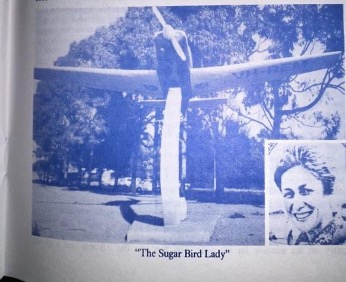
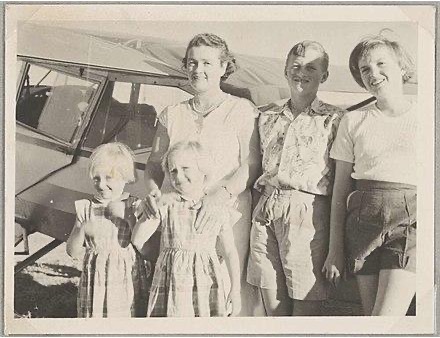
Born in 1940, Robin Miller (Dicks) was an Australian aviator and nurse, the daughter of Capt Horrie Miller and the writer, Dame Mary Durack. While training as a nurse, Miller obtained both a Private Pilot Licence and a Commercial Pilot Licence. She approached the Western Australian Dept of Health to ask for permission to fly to remote northern Western Australia and carry out a vaccination program. Permission was granted, Miller borrowed money to purchase a Cessna 182 and set out on her first flight in May 1967. She would treat children with the Sabin vaccine in sugar lumps. Hence she was known as ‘The Sugarbird Lady’. Later, Miller became a pilot for the Royal Flying Doctor Service. In 1973 she married Dr Harold Dicks but at 35 years, her life was cut short by cancer and Miller passed away in 1975.
Peg Kellman OBE:
Peggy (Mackillop) Kelman commenced flying training in 1931 at the Aeroclub of NSW, gaining her A Licence (PPL) in 1932 and Commercial Pilot Licence in 1935. She took a position as a pilot with Nancy-Bird Walton, barnstorming in western NSW and was one of the first females to work as a commercial pilot. The pair were known as ‘Big Bird’ and ‘Little Bird’. Kelman married a grazier and after their marriage in London, the couple purchased a used twin-engined aircraft, a Monospar and flew it home to Australia. Kelman only claimed one flying record, the first and only pilot to fly from England to Australia while pregnant. She remained an enthusiastic aviator owning a succession of aircraft and, in her eighties visited the Oshkosh Airshow in Wisconsin. On a trip to the Antarctic, Kelman persuaded Dick Smith to take her by helicopter to land on the ice. In 1978. Kelman was appointed an OBE in Australia “For service to aviation in Queensland, particularly in the promotion of women in aviation.”
Category 3 criteria:
Harold Gatty Memorial Trophy – Awarded to the winning Pilot and Winning Navigator with a combined total of less than 500 hours.
Background:
Harold Charles Gatty was born at Cambelltown in Tasmania in 1903. In 1917, he entered the Royal Australian Naval College at Jervis bay, in New South Wales. After a few years, he became a merchant seaman, serving on various ships plying between Australia and New Zealand. He had developed a keen interest in navigation by this time.1927 saw him take up residency in the United States of America. There was widespread public interest in Aviation, but methods and instruments for aerial navigation were woefully inadequate and in Los Angeles, Gatty opened a small navigation school and laboratory, repairing instruments and making air-route maps. His revolutionary ideas on navigation attracted the attention of many famous American aviators. He also worked with the U.S. Navy Lieutenant Commander P.V.H. Weems, on a Manual entitled “Weems System of Air Navigation”.
In 1930, Canadian pilot, Harold Bromley, invited Gatty to be his navigator on a flight which was to be the first attempt to cross the Pacific between Honshu in Japan and Washington in the U.S.A. After to return due to fuel tank problems. With no radio and fog all the way, Gatty navigated Bromley back to their starting position on Honshu, using only his dead-reckoning techniques. The flight may not have been a success but to Gatty, his instrument, a Ground Speed and Drift Indicator, which he had designed and constructed, had proved itself.
Then one eyed pilot, Wiley Post entered Gatty’s life. In 1931, Post enlisted Gatty to be his navigator on an attempt to break the record for a round the world flight. The aircraft chosen for the flight was a single-engined Lockheed-Vega, which they called the “Winnie Mae”. It had a 510 h.p. Wasp motor with a cruising speed of 150 m.p.h. (with favourable winds). With 500 gallons of fuel, its range On 23 Júne, 1931, Post and Gatty embarked on their epic flight. First stop was Harbour Grace, Newfoundland, then on to Chester, England. Berlin was the next landing, followed by Moscow. On to Novo-Sibirsk (Siberia) and then Blagoveschensk (Siberia). They then headed for Alaska touching down at Nome. Edmonton, Canada provided them with a riotous reception and a problem.
The airfield was a mire and the “Winnie Mae” could not get a footing to take off. A rare spectacle ensued – Portage Avenue, a main thoroughfare in Edmonton, was to become a runway for the “Winnie Mae”. Power lines were removed to enable the aircraft to roar down the Avenue’s tram tracks, past shops, flats and cheering crowds on the final leg of their journey. Finally, New York, their starting point, was on the horizon. In eight days, 15 hours and 51 minutes, they had covered 15,500 miles (24,939 kilometres). An amazing feat. Their actual flying time was 106 hours 8 minutes. Post and Gatty were treated to a ticker-tape welcome in New York. Instant fame for both men. Gatty was awarded the D.F.C. the first non-American to be given this high distinction. The President offered him immediate American citizenship, but Gatty declined. Gatty was appointed head of the Air Navigation and Training Research Unit in the U.S. Air Force.
Category 4 criteria:
The Pam Keating (nee Raper) and Elva Rush Award – Awarded to the winning Pilot and Winning Navigator over the age of 50 years.
Background:
Elva Rush (previously Elva Raper) initiated these trophies to honour her daughter Pam Keating (née Raper), who gave many years of service to the Victorian Branch, and who was herself a meticulous private pilot in both fixed and rotary wing aircraft.
The awards were originally known as the Pam Keating (née Raper) Memorial Trophies and were instigated to encourage women over 50 years old to commence or continue flying competitively and for pleasure. Since Elva’s passing, the trophies have been renamed as the Pam Keating (née Raper) and Elva Rush Memorial Trophies in recognition of Elva’s significant contribution to AWPA and are donated by the Victorian Branch.
These awards are donated each year by the AWPA Victorian branch, the recipient is able to keep the award they are presented.
Pam Keating (16/11/1954 – 26/01/2009)
Elva Rush (03/07/1932 – 10/06/2021)
Section B – Non-members
The winning crew of a mix of members and non-AWPA members will be awarded a prize.